
Please visit the new blog for more Cannabis & Hemp
marijuanacannabis.wordpress.com

The only specialist equipment required for the simplest indoor soil set-up would be seeds, organic nutrients, a light and a timer. The remaining equipment - soil, pots, fans, reflective materials and such should be easily available in most countries.
As an organic compound, soil is less sensitive to changes and small variations than a synthetic medium like rockwool. It could be called a self-regulating environment. Thus, pH testing equipment is usually not required.
Similarly, organic nutrients are gentler to plants than the concentrated salts and minerals of hydroponic feed mixtures. Therefore, while it is still possible to over-fertilise an organic system, such a mistake is less likely to 'burn' or kill plants. An EC meter is not required for soil growing
In short, soil growing is easier and more forgiving of growers' mistakes. Therefore it is a highly advisable method for the first time indoor grower.
The advantages of growing hydroponically indoors
Indoor cultivation allows more control over a plant's life cycle than outdoor. In the same way, hydroponic cultivation allows the grower an even greater level of control.
Since plants in a hydroponic setup are growing in a synthetic, neutral medium the grower is able to dictate exactly which nutrients are given to a plant, and at what levels. Of course, this requires more care than organics and usually necessitates the use of a pH meter (to measure acidity in water) and an EC meter (to measure the level of nutrient in water by means of its Electrical Conductivity).
Hydroponic growing mediums are less bulky and heavy than soil, often easier to handle and possibly easier to dispose of. Pests and fungus are less likely to flourish in rockwool or similar mediums, and are almost never endemic to newly bought synthetic mediums.
Hydroponic nutrients, since they are highly concentrated, take up less space than organics, especially for large crops. They are usually pre-mixed and do not require the grower to supplement them or combine several different formulas. Also, they will often smell less than organic nutrients.
In short, the more in-depth control available with hydroponics, when managed effectively, allows for a bigger, more potent and sometimes even faster crop. While such systems are not recommended for first-time indoor growers, those who have experienced success with soil cultivation indoors may wish to try this as the next step in refining their technique.
The advantages of growing outdoors
Outdoor cultivation requires less equipment, expertise and labour.
For the first few weeks of life, outdoor plants need the same care and attention as indoor ones. However, once a few basics have been well established, outdoor plants may be left (in a good, sunny spot) to take care of themselves. They may need to be regularly watered and fed and, occasionally, pruned but most of their development will be accomplished simply by allowing them to grow over spring and summer.
This feature of outdoor cultivation is what makes 'guerilla growing' possible. Established plants may be placed outside in remote or wild areas and left to their own devices throughout the growing season. The guerilla grower need only visit them a few times in this period, or even just the once, at harvest time.
Outdoor plants will usually yield more than indoor ones. This is simply because they are able to grow larger. Few indoor setups are able accommodate plants larger than 180cm. Assuming that detection is not a problem, outdoor plants may comfortably grow to 2 or 3m in height. It is possible for a single plant of this size to produce 500g or more of dried bud.
Germinating seeds early in the growing season (March or April in the Northern hemisphere) will allow your plants a long vegetative period before flowering is triggered by the shorter days of late summer.
Some people prefer the taste and effect of organically grown cannabis. Many cannabis lovers insist they can easily differentiate between buds grown with soil and sun and those produced with hydroponics and grow-lights. This, however may simply be the result of their smoking over-fertilised indoor cannabis, or even the fact that indoor buds can taste very different, due to their containing an uncommonly high level of THC that is simply not attainable outdoors.
 Scientifically (and legally), all cannabis is Cannabis Sativa L.. In practice, Indica and Sativa are the names used to distinguish each end of the cannabis 'spectrum'. There are a multitude of different growth-patterns, qualities and effects within this spectrum, most of which are a result of cannabis' remarkable ability to adapt to its environment. Genetically, and in terms of interbreeding, all cannabis is in the same family. The Sativa 'high' and the Indica 'stone' are difficult to compare in terms of power. The immediate hit and rich taste of an Indica may seem more powerful initially; a Sativa may have a subtler, yet far more profound effect.
Most Indica varieties come from southern Asia and the Indian subcontinent (Afghanistan, Pakistan, India, Tibet, Nepal, etc.).
Indicas are compact and stocky, with dense, heavy, fragrant buds. Indica buds tend to grow in clusters, with varying amounts of space (known as 'internode space') between each cluster.
Indicas are the faster flowering varieties, usually with a flowering time of 6 to 9 weeks.
Indicas do not tend to gain height rapidly once flowering has begun. An Indica may be expected to gain between 50 and 100% of its vegetative height by the end of its flowering period.
The effect of Indica is generally classified as a 'stone', meaning that it is more centred on the body. It may enhance physical sensations such as taste, touch and sound. It has a relaxing effect - mentally and physically - and may be soporific in larger doses.
SATIVA:
Sativas generally originate in the equatorial regions - Thailand, Cambodia, Jamaica, Mexico, etc.
Given the same conditions, Sativas grow taller than Indicas. Sativa buds tend grow larger than Indica, as they run along the length of a branch instead of clustering around the internodes. However, they will usually weigh less than Indica when dry, due to their lower density. Sativa buds also tend to have a less striking odour, both when growing and when dry.
Sativas take longer to flower. They will usually need between 9 and 12 weeks to finish blooming. However, they need far less vegetative time BEFORE flowering than Indicas. So the overall time required for Sativas is about the same as for Indicas (and sometimes less in terms of 'light hours')
Sativas will usually continue to gain height while flowering, often gaining 200%, 300% or more of their vegetative height while flowering. This is because around the equator there is not so much difference in the number of daylight hours between winter and summer. Therefore, Sativas in their native environment will grow and flower at the same time. For this reason indoor growers should not allow a Sativa too much vegetative growth before inducing flowering. When growing from clones, many Sativa varieties may be flowered as soon as the clone has rooted.
Despite their lower weight and potentially longer flowering time, Sativas are valued by many growers for their 'high' effect. This high may be characterized as cerebral, energetic, creative, giggly or even psychedelic. It is less overpowering than the Indica 'stone', and less likely to send the user to sleep.
 The sponsors of a medical cannabis initiative appearing on South Dakota’s ballot in November are suing the state Attorney General over his misleading summary of the initiative, apparently designed to encourage a negative reaction in voters. The AG must write a neutral summary of each state ballot initiative. In this case, his first act was to rename the measure.
 Anyone who enjoys even a casual relationship with our favourite plant must be aware of the vast gulf between the official portrayal of cannabis and their own real-world understanding of it.
 Apologies if the title of this piece is an obscure reference. It is taken from the recent debate in the US, about whether the science classes of public schools should teach ‘Intelligent Design’ as an alternative theory to evolution.
 The art of cloning plants could be the most useful of all ‘indoor’ techniques. Cloning allows growers to make the most of every female plant and it’s a skill that anyone can master with a little practice.
Outdoor growers who clone their plants are able to identify gender early in the season and multiply their female plants during the long vegetation period. With low-powered artificial lighting, a promising female can even be preserved for next year’s outdoor crop.
Due to its common association with indoor growing and hydroponics, cloning might appear to be a complex process. In fact, nothing could be further from the truth.
Just as cannabis seedlings will take advantage of the smallest chance to grow, cuttings will quickly make roots and become healthy small plants if a few conditions are met.
Good cuttings are made from strong, green stalks, preferably the growing shoots of the stem and branches.
If possible, cuttings should be 10-20cm long and a few millimetres thick. Avoid stems that are turning woody or hollow, as these are less likely to root. If the aim is to produce a few strong cuttings from each plant, growers should select 12cm sections of the healthiest top shoots. Larger cuttings have more energy and have a better chance of surviving.
If the aim is to make as many clones as possible, any 5-10cm piece of green stem with a growing shoot and a leaf or two can be used. A 30cm branch can be cut at each internode, making 3-6 clones. Tiny cuttings can also turn into clones, though they may take too long to grow to a decent size after rooting. Nevertheless, pieces of stem 3cm long and 1mm thick can root with vigour in bright, humid conditions.
Before planting, treat cuttings with rooting hormone in powder or gel form.
While a good soak in rooting solution is enough to get many clones started, a final treatment with a rooting aid that clings to their stems will increase success rates.
With a razor blade, make a diagonal cut to remove the last millimetres of stem, then dip the cutting in hormone powder/gel. To encourage rooting, many growers gently scrape the lower stems before dipping. A disposable safety razor is a good way to remove a couple of ultra-thin slices from the stalk.
Place treated cuttings in a moist, airy medium that holds them firmly – expanding peat tablets, a 50/50 mix of soil and perlite, cocoa-fibre or rockwool, if available. Clones have no problem rooting in a small rockwool block, then being transferred to soil.
After planting, outdoor clones are given the natural light cycle. Some growers shade rooting clones during the hottest part of the day, while others adopt a ‘survival of the fittest’ attitude. Viable clones will appreciate direct sunlight, and should root quickly.
In hot, dry climates, rooting clones may require a transparent covering to retain humidity. Keep the clones’ medium moist, but not saturated. In good conditions, clones should root in 10-20 days.
Cloning for Sex
The first clone taken from a plant can reveal the parent’s gender with 100% accuracy. It’s easy to reduce the light cycle of cuttings – allow them 12 hours of daylight, then cover them or move them to a dark area. This is much simpler than covering a single branch of a large plant to reveal gender.
When seed-plants reach 30cm, they can yield a cutting or two, which can be given a 12/12 light cycle immediately upon being planted. They will show their gender in 10-14 days, and in many cases they’ll root as well.
It’s fine if these first clones don’t become healthy small plants. Their purpose is to reveal the gender of the parent early in the season, allowing males to be eliminated and all subsequent cuttings to be taken from female plants.
As an added bonus, cloning for sex causes seed-plants to be ‘topped’ early in the season, leaving plenty of time to regenerate a strong double-stem.
Cloning to Multiply
Outdoor growers with plenty of space may clip plants to train them into huge bushes, while balcony growers often cut plants solely to restrict their size.
In both situations, cloning allows extra plants to be made from foliage that is normally discarded.
To keep a balcony plant around 1m by the end of flowering might require quite a lot of pruning. Instead of throwing away over 50% of a female plant during the growing phase, the removed foliage can be made into dozens of copies that plant, all of which will finish under the required height.
Growers who prune plants to make them large and bushy can produce huge numbers of clones. Branches are clipped at regular intervals throughout the vegetative phase to encourage them to split and grow in two directions. As plants increase their size and number of branches, each pruning will yield more cuttings than the last. While this might eventually produce more cuttings than most growers could use, remember that a rooted female clone makes a lovely gift.
Late Cloning
Indoors, cuttings are almost always taken while plants are in the growing stage, as the aim is to preserve a plant in its vegetative state. Outdoors, it is even possible to take clones during the initial weeks of flowering, when the first single flowers begin to show. Cuttings from plants that have begun to flower will often root more quickly than normal clones and should continue blooming at the same rate as the parents.
This means that even in the final, pre-flower trimming (where lower and inner branches with little budding potential are clipped), outdoor growers can clone any viable pieces of stem that are removed from plants.
Every green section of stem with a healthy internode can become a small plant when treated with kindness. Six branches cut from a medium-sized plant in July or August could be turned into 10, 20 or 30 cuttings. Even with a low survival rate of 20%, the result can be a few bonsai flowering plants.
If you’re growing outdoor plants this year and you’ve never made clones, you could try the following experiment just to see how easy it is to produce them, even if you have no particular need to multiply your harvest.
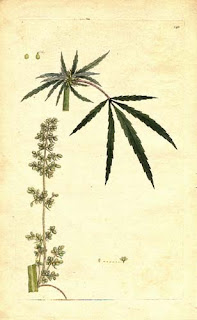 Hemp is one of the oldest crops domesticated by man. The history of hemp in
 The Dutch Golden Age was also the golden age of Dutch hemp in
Only after Czar Peter the Great learned about shipbuilding in the Dutch ‘zaanstreek’ (an area in the north of
The most towns and villages used to have their own ropewalks for the production of hemp-rope. These long lanes (now often a shopping street in the middle of town) were right along the city wall or just outside of it. Some places specialized in the production of hemp-rope, for example the city of
Generally it is thought that linen is only produced from the flax plant but in the past and way into the 20th century, linen was also produced from hemp. The male plants were used for making linen and sails because the fibers are finer then those of the female plant. Or the coarser fibers of the female were used for making more heavy canvas (from “cannabis”) and rope.
The hemp was grown on small artificial islands right next or close to the farm. The water level could be regulated with little dams, and to protect the plants against strong winds a line of pruned willow trees was grown around the outer edge of the plot. These characteristic small islands can still be recognized in the countryside today in the middle of
Hemp-stalks are harvested and then put for a while in water to start a rotting process, called ‘retting’. Bacteria start to break down the connections between the bark fibers so they come loose from each other. This also happens when the stalks are left on the field for a while and rain or dew regularly wets them. After this, the stalks are dried and the fibres are peeled off the stalks. They can also be broken in a special device called the ‘breaker’ so the bark fibre comes lose from the inner wood core. Windmills were sometimes used for this process.
After breaking, the bundles of bark fibre are cleaned further by first hitting them with a flat piece of wood to clean off the last pieces of remaining wood core. Then the fibers are combed on various sizes of ‘hackles’
The clean bundles of fibres are spun to fine yarn to be woven into textiles by the weavers. The production of hemp-linen and heavy canvas is very labour intensive, to make 1 meter of cloth takes at least 25 hours of work. A long time ago, canvas and linen were not cheap products. This was the reason why many painters could not afford the canvas for their paintings. A good way to deal with this is by making a painting of the weaver and his family, on an available wooden panel. These paintings were then traded for canvas. This is the reason why there are many paintings of weavers.
In the past, the hemp plant was important for its fibre and its seed but it was available on the shelf of the drugstore as a medicine. The psychoactive effects of hemp certainly didn’t stay unnoticed. On top of that was that the price of tobacco in the 16th and 17th century was very high and farmers and poor people could not afford pure tobacco. This was the reason that in these times many tobacco mixtures were sold to make the tobacco affordable (and tasty!). Already people were puffing away in this time, including certain painters.
Numerous painters preserved smoking scenes of the 17th century where they are clearly under the influence. Take a look at various representations of smokers by painters like Adriaan Brouwer, David Teniers (de Jonge) and Paul van Ostade and others. Many times you can see hemp seeds in the ashtray and the old matches were also hemp-branches, so everything points in the direction of a lot of hemp smoke.
There are examples of smoking tobacco-hemp mixtures in

In the States where the smoking of Marijuana was already well established, enthusiasts were also breeding cannabis with seeds from around the world. Predominantly pure Sativa types were preferred due to the type of high that they gave, but these pure Sativa types were not indigenous to the States and rarely matured in time. Many hybrids were created from pure Sativa’s, mostly from Thai, Columbian, Mexican and South Indian landrace plants. During the mid to late seventies Cannabis Indica seeds were introduced into the States, including Afghan #1, Mazar-I-Sharif, Chitral and
Breeders crossed these early maturing Indica varieties with the sweeter but late maturing Sativa’s. Some of the earliest Sativa/Indica strains were bred by Sacred Seeds including Skunk#1 ((Columbian x Afghan#1) X Acapulco Gold), Original Haze,
In the early eighties, these strains and many others such as; Early California, Thai, Columbian, South Indian, Early Girl, Hawaiian Indica, Californian Orange and South African landrace genetics, were brought to
Three major players of that time, with an interest in finding superior plants, started to grow out the Skunkman’s seeds: Ben Dronkers of Sensi Seeds and Eddie, who founded the Flying Dutchmen Seed Company and the Cannabis College, worked together with the Skunkman for many years, setting up a successful seed wholesale business in the early eighties. The third pioneer is the infamous Neville, the previous owner of the
The base genetics for almost all of the strains that are found in
The key to breeding superior seed stock is the selection process. Eddie, Ben and Neville grew out tens of thousands of each strain to isolate those exceptional plants. Greenhouses of up to 20,000 square meters were used with darkening systems to manipulate the natural photoperiod, with this method, two crops a year could be harvested. At first, the rejuvenation of fully flowered, selected mothers and fathers was a hit and miss task.
The Americans were successfully taking cuttings from cannabis still in its vegetative stage, this technique revolutionized the Dutch growing scene. Cuttings could be taken from all the plants during the vegetative period and maintained until the plants were mature and the selection process was carried out. These selected plants have been faithfully maintained ever since by Sensi Seeds and The Flying Dutchmen. Today, research and development still form a large part of their work.
 Cannabis sativa L. is the scientific name given to the cannabis or hemp plant in 1753 by the Swedish botanist Carolus Linnaeus. Since then, three main types have been identified:
- Cannabis Sativa
- Cannabis Indica
- Cannabis Ruderalis
Sativa
Probably the most common form of Cannabis worldwide and also the type with the most applications. As a botanical name, sativa simply means ‘sown’ and is applied to the cultivated or common form of many agricultural crops.
A typical Sativa is a tall plant, generally a lighter shade of green than the other types. Its leaves are made up of long, narrow blades. Female flowers are longer and more ‘feathery’ in appearance than those of an Indica.
In general, the foliage of a Sativa is sparser than that of the other varieties Sativas grow taller than the other types, gaining height all through their growing and flowering phases. This is due to the equatorial origin of Sativas. In the tropical regions the length of day does not change very much between seasons, so Sativas are adapted to accomplish both their growing and flowering in a fairly uniform photoperiod.
The female flowers of Sativa strains usually grow along the length of the stem and branches, instead of forming in clusters around the internodes, as with the other types. This flower formation is due to the Sativa tendency to grow and flower simultaneously. As a result, female Sativa flowers are usually less dense and weigh less than Indica flowers.
A pure Sativa often requires a combined grow/flower period of around six months to ripen completely. For this reason there is no such thing as a pure indoor Sativa strain. All Sativa strains that are viable for indoor growing have been hybridised with Indica strains to make them more compact and faster to flower.
Nearly all cannabis grown for industrial purposes is Sativa. As the tallest variety it produces the longest fibres and therefore has the widest range of industrial uses.
Indica
Indica varieties are generally agreed to have originated on the Asian subcontinent or possibly
A typical Indica is a much more compact, thick-stemmed plant, usually attaining a height of less than two metres. It is a darker shade of green, some examples appearing to have almost blue or green-black foliage. Its leaves are comprised of short, wide blades. An Indica tends to produce more side-branches and denser foliage than a Sativa, resulting in a wider, bushier plant. Female Indica flowers form in thick clusters around the internodes of the plant and usually weigh more than Sativa flowers of similar size.
The life cycle of an Indica is divided into two distinct photoperiods – growing and flowering. Growing occurs when the plant is in an environment of long days and short nights. Here, the plant devotes its energy to increasing in size. As days become shorter and nights longer, the plant receives the signal that winter is approaching and flowering is triggered. Here, upward and outward growth slows or stops as the plant devotes its energy to growing reproductive parts.
An Indica requires both a growing and flowering period in order to reach its full size.
Many Indicas are a rich source of the cannabinoids THC, CBD and CBN. While a Sativa may possess a higher proportion of THC relative to its other cannabinoids, an Indica will often contain significant levels of all three. When ingested, Indicas tend to produce more bodily effects than Sativas – effects such as enhancement of physical sensations, relaxation, dry mouth, red eyes. These Indica effects are often grouped together under the term ‘stoned’, as opposed to the ‘high’ imparted by Sativas. This is not to say that Indicas have no psychoactive effect, just that they also have noticeable effects on the body.
Indicas are cultivated almost exclusively for their medicinal and psychoactive properties. Lamarck, when classifying this type, commented that Indica’s “firm stem and thin bark make it incapable of furnishing similar fibres to the preceding species (C. sativa L.) of which so much use is made".
Ruderalis
The name ‘ruderalis’ comes from the German ruderal, a term for weeds growing by the roadside or on other fallow land.
Cannabis ruderalis is an uncultivated strain native to
The differences between these three in their growing and reproductive patterns can be linked to the vastly different climates and environments encountered by the original tropical phenotype C. sativa L. as it colonised further and further north of the equator after the last ice age.
The most notable characteristic of the Ruderalis strain is its capacity to flower (and therefore reproduce) according to an individual plant’s age, independent of the photoperiod in which it is growing.
Since nearly all flowering plants take their cue to reproduce from the climatic factors indicative of season, the ability to begin this process based on changes in the plant rather than in its environment is known as ‘auto-flowering’.
A Ruderalis will begin flowering when it achieves a certain stage of maturity - normally after about seven weeks of growth, when it reaches its fifth to seventh internode. Once a Ruderalis has begun flowering, it continues to do so until other environmental factors (most notably winter) cause the plant to die. The other varieties may expire naturally once their reproduction has been accomplished, or may return to vegetative growth if given a long photoperiod.
Ruderalis’ adaptation to short, cool summers can be seen in other areas. Ruderalis has the ability to complete its life cycle – from being a seed to producing seeds - in just 10 weeks. Its seeds detach easily and can survive more than one season in frozen ground - until conditions are favourable enough to allow growth. The seeds can also survive their shells being cracked open when walked on by humans or animals. For some Ruderalis strains, this occurrence may even aid the germination of seeds.
A typical Ruderalis plant is very short in height, often between 10cm and 50cm at full maturity. It displays little or no branching and has wide, fat-bladed leaves, similar to those of an Indica. Once flowering begins, Ruderalis will gain even less height than an Indica.
Wild Ruderalis strains are nearly always high in CBD and low in THC.
While pure Ruderalis strains have little value in terms of fibre, medicine or psychoactivity, their auto-flowering capability and their extremely fast maturation time are of great interest to cannabis breeders. Hybrids made from combining Indica and Ruderalis strains are currently proving to be some of the earliest-maturing outdoor plants available.
